How to Hit More Sixes in Cricket: Power Hitting Guide
Sport I Play Team
Published
Quick Verdict
Jump to breakdown ↓Modern six-hitting in cricket relies on kinetic-chain sequencing rather than brute upper-body strength. By anchoring a stable wide base, generating hip-to-shoulder separation before downswing initiation, and matching bat launch angles (28 to 35 degrees) to delivery length, batters of any build can add 15 metres to their boundary carry.
Jump to Section (6)Expand

For decades, coaching manuals treated six-hitting as the exclusive domain of heavyweight middle-order finishers built like Chris Gayle or MS Dhoni. Then modern sports biomechanics — and fearless teenage prodigies — rewrote the rulebook.
When 15-year-old Vaibhav Sooryavanshi smashed a world-record 204 off just 53 balls with 28 sixes for India A against the UAE in Doha alongside Priyansh Arya's 19-six blitz in the Syed Mushtaq Ali Trophy, one truth stood out on every replay: elite boundary carry comes from rotational whip and sweet-spot launch angles, not bicep circumference.

Whether you open the batting in weekend T20 leather-ball leagues or want to turn boundary fours into maximums at your local turf, this complete power-hitting guide breaks down the exact mechanics, launch angles, and drills behind modern six-hitting.
1. Why Bat Speed Beats Brute Muscle in Modern Cricket
Physics governs every ball that leaves the middle of a willow blade. Once a cricket ball makes contact with the sweet spot (located roughly 15 to 22 centimetres up from the toe of the bat), three variables determine how far it travels:
- Exit Velocity (Bat-Head Speed + Incoming Ball Speed): Every 5 km/h increase in bat-head speed at impact adds roughly 6 to 8 metres of carry. Tightening your forearms and shoulders in an effort to "muscle" the ball actually slows your wrists down through the hitting zone.
- Launch Angle (28° to 35° Optimal Window): A ball struck at 18° flies flat for a one-bounce four; a ball skyed above 45° loses horizontal distance and hangs in the air for deep fielders. The sweet spot for clearing a 75-metre rope even against a slight crosswind sits between 28 and 35 degrees.
- Centred Impact & Minimal Side-Spin: Slicing across the ball imparts back-spin and side-spin that bleed carry in the final 20 metres of flight. Swinging cleanly through the line keeps the seam stable and maximizes aerodynamic carry.
2. The 4-Pillar Kinetic Chain of a 95-Metre Six
Watch high-speed footage of the world's cleanest six-hitters and you will notice their swing works like a whip, transferring energy from the ground up through four sequential links:
- Pillar 1: The Wide, Grounded Base: Instead of lunging a long way forward and trapping their hips, modern power hitters set a slightly wider-than-shoulder stance with bent knees once they commit to a boundary strike. A stable lower half gives the hips something solid to push against.
- Pillar 2: Hip-to-Shoulder Separation (The X-Factor Stretch): As the front foot plants, the rear hip fires forward milliseconds before the shoulders and hands drop. That brief torsional stretch across your core acts like a coiled rubber band.
- Pillar 3: High Backlift & Delayed Wrist Uncocking: Holding the bat cocked near the back shoulder until the hands drop into the slot allows gravity and torso rotation to accelerate the blade before the wrists snap forcefully through impact.
- Pillar 4: Full Extension Through the Target Zone: Rather than checking the follow-through at chest height, the bat continues accelerating along an upward 30-degree arc well past contact, ensuring maximum bat velocity at the exact point of impact.
3. Old-School Slogging vs. Modern Power Hitting Comparison
Here is how traditional club-cricket slogging differs from the repeatable power-hitting mechanics taught in modern white-ball academies:
| Biomechanical Element | Old-School Club Slogging | Modern White-Ball Power Hitting | On-Field Result |
|---|---|---|---|
| Head & Eye Level | Head falls toward square leg to "heave" | Head stays still and level directly over the center of gravity | Cleaner sweet-spot contact rate (>75%) |
| Footwork & Base | Pre-meditated big stride or wild charge | Stable wide base or decisive crease-depth adjustment | Unlocks 360° access (extra cover to mid-wicket) |
| Grip Pressure | Death-grip (9/10 tightness) in both hands | Relaxed 5/10 grip in setup, firming to 8/10 only at impact | +8 to 12 km/h faster wrist whip through the ball |
| Swing Path | Horizontal cross-bat swipe across the line | Vertical-to-upward arc matching the ball's incoming plane | Straight sixes over long-off/long-on instead of top edges |
| Follow-Through | Cut short or off-balance falling spin | Full two-handed or high one-handed extension over shoulder | Consistent 80m–95m carry even on slight mishits |
4. Matching Swing Plane to Delivery Length (Pace vs. Spin)
Even the fastest bat speed fails if you use the same footwork against a 140 km/h yorker and an 85 km/h flighted off-break:
Against Fast Bowlers (Using Pace & Crease Depth)
- Step Deep in the Crease to Create a Length: Standing 30 centimetres deeper inside your popping crease turns a testing good-length ball into a slot delivery you can hit on the rise, and converts an attempted yorker into a low full toss.
- Hit Through the V (Long-Off to Mid-Wicket): Against express pace, you do not need an exaggerated backswing. Focus on a compact, stable base and let the bowler's incoming velocity multiply your bat speed straight down the ground.
Against Spinners (Generating Your Own Power)
- Win the Length Early (All-In Forward or All-In Back): Never get caught on the half-stride against spin. Either use rapid three-step footwork to meet the ball on the half-volley before it turns, or rock deep onto the back foot to pull/cut over mid-wicket and extra cover.
- Clear the Front Leg without Losing Your Head: When launching a spinner over long-on or deep mid-wicket from the crease, open your front toe at a 45-degree angle so your hips can rotate freely while keeping your eyes dead level.
5. 3 Net Drills to Build Explosive Boundary Carry
Add these three 15-minute drills to your weekly net session before your next weekend match on Sport I Play Games:
- The No-Stride Stable Base Drill (18 Balls): Set your feet in a wide, balanced hitting stance before the throwdown feeder releases the ball. Without taking any further stride, hit 18 overarm throwdowns straight over the sightscreen using pure hip rotation and wrist snap.
- Heavy-to-Light Bat Overload Swings: Perform 10 dry swings at 90% effort with a heavier training bat (or two grip cones attached), rest 45 seconds, then immediately face 6 live balls with your normal match bat. Your neuromuscular system fires noticeably faster through the hitting zone.
- Range-Hitting Contact-Point Cones: Place three coloured cones along the pitch — Yellow (overpitched), Blue (good length), and Red (back of a length). Have a partner call out your target boundary zone only as the ball lands, training you to launch good-length balls over the infield rather than only waiting for half-volleys.
Want to test your new range-hitting skills this weekend or compare your strike rate with local batters? Join or host a match on Sport I Play Games and share your batting milestones in our Cricket Communities.
Frequently Asked Questions
Do I need a heavy cricket bat to hit bigger sixes?
No. While a heavier bat carries more mass, a bat that is too heavy slows down your bat-head speed and delays wrist snap. In kinetic energy formulas ($KE = \fracmv^2$), velocity ($v$) is squared while mass ($m$) is not — meaning a lighter 2lb 8oz or 2lb 9oz bat swung 8% faster generates significantly more six-hitting distance than a sluggish 2lb 12oz blade.
Why do my lofted shots keep going straight up instead of carrying over the rope?
Popping the ball straight up in the air usually happens for two reasons: leaning your upper body backward while your head falls away (which tilts your launch angle above 45 degrees), or hitting the ball too late behind your front pad instead of out in front of your lead hip. Keep your chest over your knees and contact the ball 15 centimetres ahead of your front foot.
How can a shorter or younger batter hit sixes like Vaibhav Sooryavanshi?
Younger and lighter batters generate elite distance by maximizing kinetic-chain efficiency: setting a stable wide base, rotating the rear hip aggressively before the hands drop, keeping a relaxed grip until the final millisecond of wrist whip, and timing the ball on the upward arc of the bat swing.
Share This Guide
Play cricket near you
Join a local cricket community, find players at your level, and get on the court this week.
Sport I Play Team
The Sport I Play editorial team — passionate sports enthusiasts covering technique tips, fitness guides, and sports stories.
Keep Reading in Cricket
All Cricket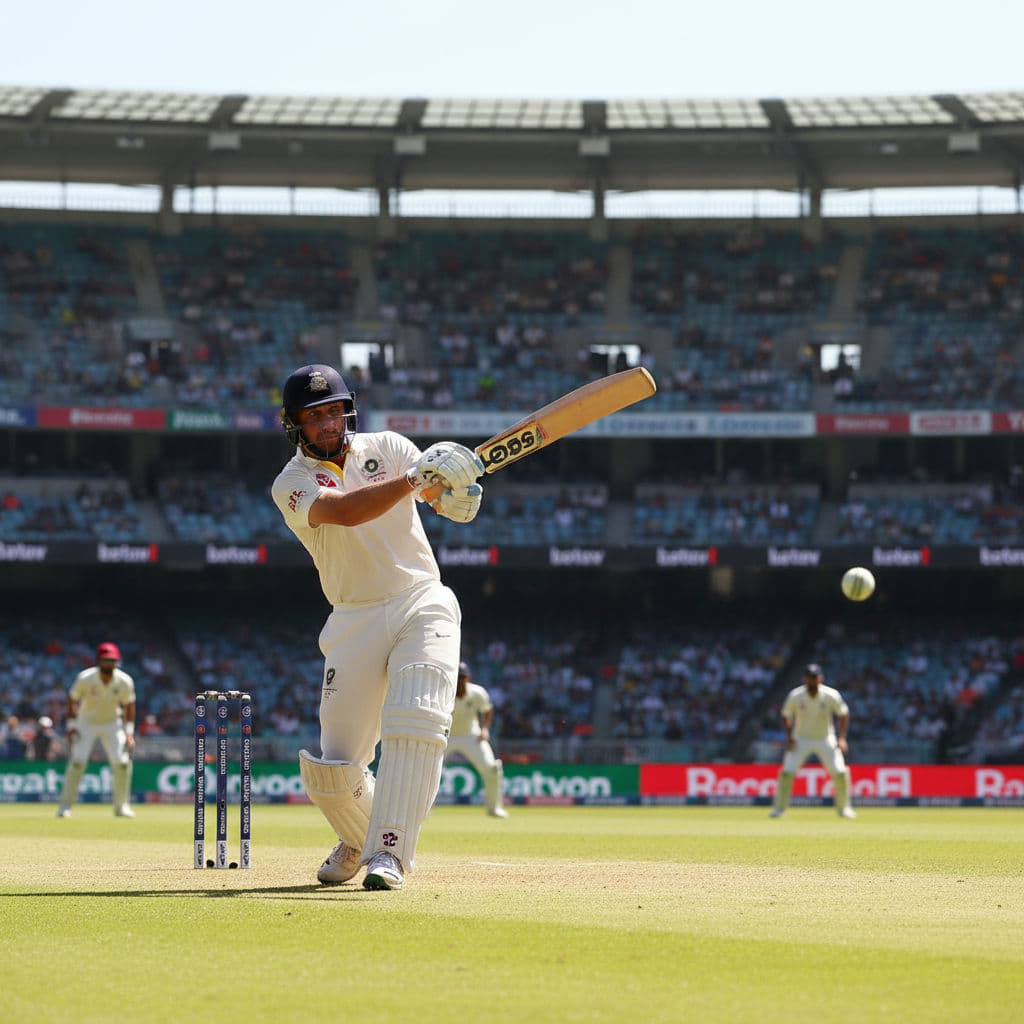
Cut Shot in Cricket: Master This Power Stroke [Guide]

How to Win a Cricket Series Decider: Test Match Tactics Guide

How to Bat for a Draw & Survive Day 5 in Cricket: Full Guide

How to Time a Cricket Declaration & Take 10 Wickets: Full Guide

How to Convert 50s into 100s in Cricket: Complete Guide

How to Open the Batting in Cricket: Leave & New-Ball Guide